Is there a technology more contemporary yet timeless than sheet glass or mirrors?
13 May 2010
7 May 2010
Privacy and Honour
I received a staff e-mail the other day on the subject of data protection which asks members of academic staff to be very careful with the personal information in their possession about students.
“Be particularly careful if you are in possession of sensitive personal data (i.e. information relating to race, political opinion, physical or mental health, religious belief, trade union membership, sexuality, criminal offences etc).”
It’s easy to see how such regulations emerge and evolve as society becomes more concerned about litigation, but despite the increasing nuances (and the possible protections these afford) there’s rarely ever an attempt made, on the part of the people handing out the “advice”, to deal with or seek to expose the complexities and contradictions which are embedded in such measures. For example, how are we to ascertain what is really meant by the word “sensitive” in this context? If someone is heterosexual, should we consider this to be sensitive information, and who decides? If someone supports the Labour Party is this any less sensitive data than if they’re an Anarchist? And what about personal information that people broadcast without even realizing that they’ve done so?
The problem with injunctions that ask us to “be careful” is that they’re often so vague that we’re forced to form our own judgements about what is or isn’t appropriate and these can sometimes lead to absurd levels of caution. In this context it’s perhaps understandable that, during discussions with students, we tend to refrain from the mention of potentially sensitive subjects because we don’t wish to be accused of a breach of any kind, but if you take this to a logical conclusion, it's not difficult to imagine a situation where we may feel compelled to say to students that we don't wish to discuss any personal subjects whatsoever, and where would that leave us, especially in fine art where personal expression is still a much vaunted practice?
The problem with injunctions that ask us to “be careful” is that they’re often so vague that we’re forced to form our own judgements about what is or isn’t appropriate and these can sometimes lead to absurd levels of caution. In this context it’s perhaps understandable that, during discussions with students, we tend to refrain from the mention of potentially sensitive subjects because we don’t wish to be accused of a breach of any kind, but if you take this to a logical conclusion, it's not difficult to imagine a situation where we may feel compelled to say to students that we don't wish to discuss any personal subjects whatsoever, and where would that leave us, especially in fine art where personal expression is still a much vaunted practice?
Shared personal information creates a bond of trust between people, especially if they’re friends. The value and meaning of this bond is based on a two way relationship which acknowledges both the value of privacy and the possibility of betrayal. Friends are, in part, judged on their discretion and trustworthiness. But institutions also hold personal information about individuals associated with them and are consequently obliged to be extremely prudent about how they treat this information. Teachers, as representatives of institutions, also carry this burden of responsibility and it's therefore understandable that they should be very careful with any personal information in their possession. The problem which concerns me here, arises through the conflict between institutionalisation and self-regulation; between the institution's desire to meet its legal responsibilities and the integrity of its representatives. Now, you might say that there doesn't seem to be a conflict here: both parties desire confidentiality. This is quite correct, but the important aspect is not what is desired but how this aim is brought about. Just as friends are judged on their discretion, so teachers are judged on their integrity, and integrity, as we all know, is something which certainly doesn’t come as an automatic consequence of regulation. I'm far from arguing that every teacher is every student's friend but I do think it's important to recognise that the more structures put in place to regulate the behaviour of teachers, the more difficult it becomes for them to distinguish themselves by their conduct: in this case, their custodianship of other people’s personal information.
This isn’t an argument for greater recognition of teachers (though this is arguably also an area which is being eroded) but rather about principles and most especially about how these principles are inscribed and cultivated within the very fabric of the institutions which also cultivate future generations and contributors to society. Is it not ironic that the very institutions who are entrusted with the authority to bestow “honours” by the thousands to graduating students each year, think so little of the concept of honour itself and seem to have so little understanding of how it is nurtured?
Personal data is sensitive either because it can be used to discriminate against people or because it can expose emotional vulnerabilities. I’m certainly not suggesting that we should be more relaxed with personal information but I think the attempt to mitigate against abuse in this way has the unfortunate side-effect of perverting the value and authenticity of well-established social codes which, whilst they may be open to abuse, at least treat people as discerning, self-regulatory and principled beings rather than untrustworthy infants who need to be kept in line. This is one of the worst things you can do with legislation – pass it down the chain, with no invitation for discussion of how best to utilise and apply it, as if it were so much uncomplicated common sense. And this is where the subtle but important point lies: at it’s best, legislation augments social codes by enshrining them in law and ensuring that everyone has equal protection and equal opportunities for justice and fair treatment. In many ways such institutionalization is perfectly reasonable, but from another perspective there's the danger that it simply substitutes one flawed system for another: accountability stripped of understanding, conformity robbed of scrutiny and obligation devoid of trust. Personal information has become a liability for teachers – no longer is it something which creates a bond, but rather a contractual obligation reinforced by the threat of civil action.

To return to the original point, I think where we most need to be “careful” is in the use of the words we use to describe the objects of data protection. The word “personal” is misleading for the simple reason that, as a concept, it straddles both the public and private realm and is completely unaltered by the shift between them. There’s no clear emphasis or imperative about the concept of the personal to suggest that it should be maintained in its present state, whereas “Private” information on the other hand can only ever be private, by definition. So if you want to make it quite clear that something is confidential - and therefore should not be divulged - then it’s probably best to tell people that it’s private. And if you’re in any doubt about the imperative that this lends then consider for a moment the change in emphasis if you replace it with the word “secret”.
1 May 2010
This guy's ripping me off
Stephen Willats thought that Art & Language were ripping him off
Art & Language thought that Joseph Kosuth was ripping them off
Joseth Kosuth thought that Lawrence Weiner was ripping him off
on a recent trip to London Lawrence Weiner saw a show by Stephen Willats
he said fuck me this guy's ripping me off
“Circle”, owada (Martin Creed)

Untitled, contact print, 1985
I spend much of my teaching life giving ideas away to students. I try to keep these ideas as rudimentary as possible because I believe it's important for students to generate their own more sophisticated solutions - after all, it's usually they who initiated the ideas in the first place. Sometimes we just need a gentle nudge to help us along our way and to allow us to discover a new perspective upon our work - so a suggestion, no matter how vague or clumsy (and mine are often both), is often helpful to clarify our direction.
This process of sharing ideas, and most especially the possession of them, is fraught with difficulty, especially for artists who work in close proximity. House-styles emerge because artists influence and inspire one another. Movements arise for the same reason, but perhaps contain a wider variety of approaches and fewer tendencies to mimic visual appearances to the detriment of content. For this reason, house-styles are viewed with suspicion whereas movements (isms) are viewed as progressive. But how can a movement really evolve without a certain beginning in a house-style? If artists are so anxious not to mimic one another how can they develop a shared vision without creating possessiveness, bitterness and suspicion?
Some years ago a student once said to me “I don’t mind people ripping me off Jim – I’ve got loads of ideas.” Of course, for some of us the process of developing ideas is a much more involved process, so to the extent that we’ve invested research, struggle and emotion in our work it can be frustrating to see other people taking what appears to be easy advantage of our hard-won effort.

Untitled, C-type print, 1986
When I was a student the artist and visiting lecturer Mari Mahr praised me on the images I was making using a Diana camera, but I was put off continuing with them because another more senior student was using the Diana too (and to me he was doing a much better job). During a later visit she asked me why I’d stopped using the Diana Camera. I said “Because so and so uses a Diana camera too” to which she replied – “That’s easy – all you have to do is make more images than him”. I did, and we soon found our own individual ways to be distinctive.

Untitled, C-type print, 1986
There's a related, but perhaps more troubling situation, where, like Capt Scott, you toil towards something only to find that it's already been discovered. The feeling of disappointment in such situations is directly proportional to the investment made. At least when you rip someone off you’re under no illusions that you’re standing on the shoulders of giants – or perhaps more accurately - on the shoulders of someone else’s giant. But ultimately the reward that comes as a result of genuine effort is yours alone, in so far as you understand how you got there and next time you'll be all the better prepared for the difficult but potentially highly rewarding journey.
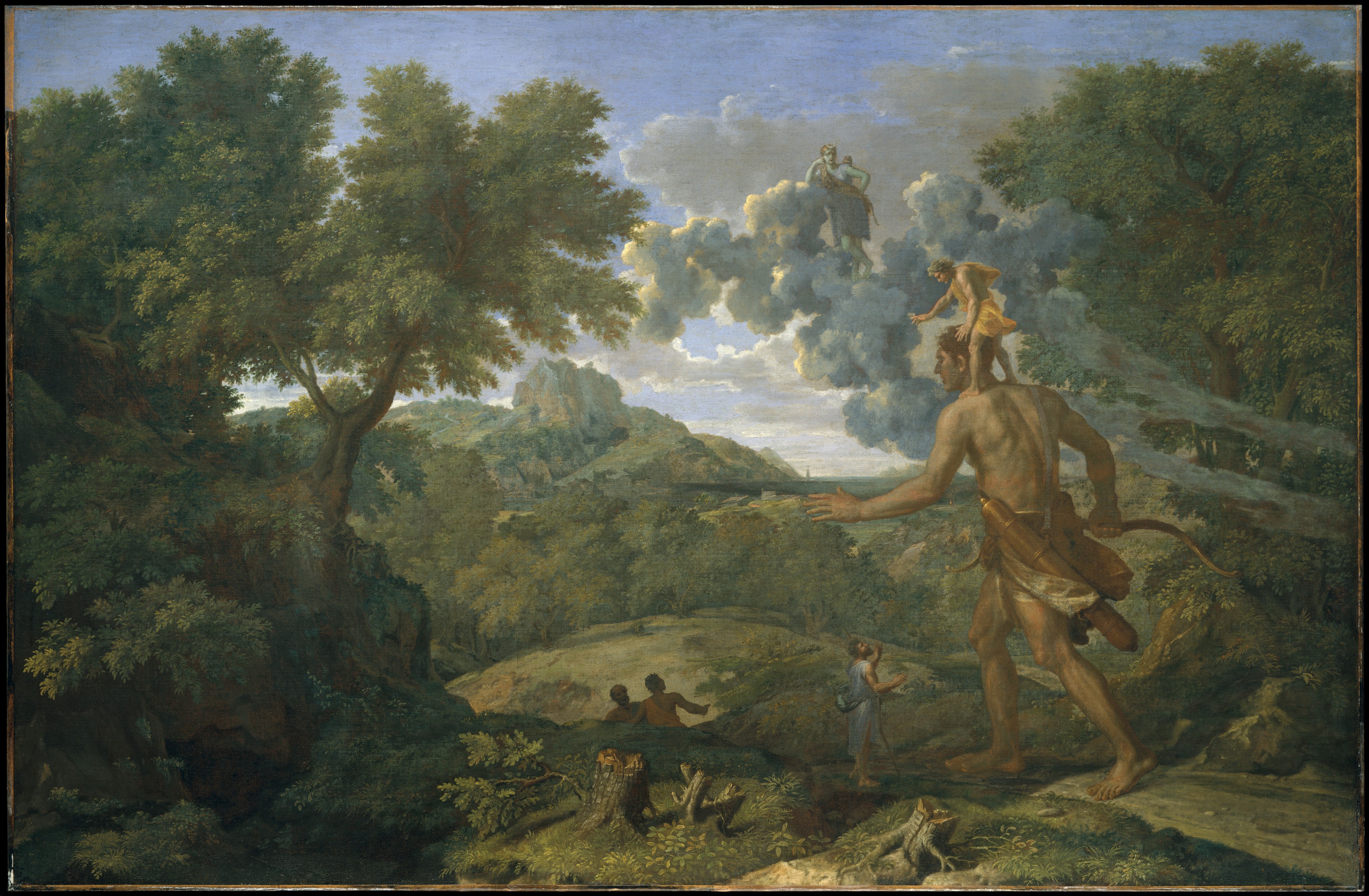
Cedalion standing on the shoulders of Orion from Blind Orion Searching for the Rising Sun by Nicolas Poussin, 1658
21 Apr 2010
Conventional Eccentricity

“Eccentricity has always abounded when and where strength of character has abounded; and the amount of eccentricity in a society has generally been proportional to the amount of genius, mental vigor, and moral courage which it contained. That so few now dare to be eccentric, marks the chief danger of the time.” John Stuart Mill (1859)
It has almost become a present day truism that artists are nonconformists, but if this is true, I have to say that I haven’t really noticed. Yes, artists tend to be left-wing secular humanists (though they might not describe themselves as such) but this would seem to be more a proof of homogeneity than nonconformity. Undoubtedly, there has always the occasional “eccentric” with prominently unconventional tastes, fashion style, beliefs or demeanour, but in general, artists are pretty well as orthodox as everyone else in society. You’d certainly be hard-pressed to distinguish an artist from a line up of randomly selected individuals. Of course, nonconformity isn’t specifically attributable to appearances, it can just as easily cover attitude, lifestyle, philosophical or political beliefs etc, but once again, most artists aren’t radically different from many other people in these respects either.
So, has something changed in the modern period – and if J.S Mill was right, are we in some kind of moral and creative hiatus or worse still peril? Have artists become so cowed by social pressure that they’ve lost the ability or confidence to stand out from the crowd? This seems highly unlikely. If you look at images of groups of artists from any period you’ll notice that, for the most part, they look pretty much like everyone else of the time (though photographs of Yves Tanguy in the 1920’s, with his characteristic gravity defying pre-punk hairstyle, are perhaps a memorable exception).
Why might this be the case and what might the apparent conformity of artists tell us about art itself? Firstly I think we need to examine why people in general might wish to conform. Critics of conformity often suggest that it’s because we’re afraid of the persecution or rejection which might arise from making our opinions public, and that conformity is simply an expression of our fear and lack of self confidence. Mill’s remarks above echo as much, but I think this is perhaps too simplistic and reductive an explanation.
Conformity allows us to feel as though we’re part of something and since we’re social animals this is probably no bad thing. Admittedly, it also provides a certain stability and security which, whilst clearly desirable in any healthy society, can easily lead to unquestioning attitudes and critical indolence. But conformity also provides an ease of choice - since we need not constantly expend energy on questioning - and arriving at considered opinions about - absolutely everything we encounter. To be this unconventional would take such an inordinate amount of effort as to be impossible. Life’s simply too short. For this reason, we have little choice but to accept many of life’s “norms” as, at least, provisionally adequate to our present purposes. So, whilst there may be certain aspects of anxiety-avoidance involved in our conformity, the more compelling explanation appears to be because we simply have better things to spend our time and energy on. It’s a question of priorities, and this is where I think conformity can tell us something very important about artists and art.
In their own creative practice, artists are also necessarily far more conventional than might be thought to be the case and this is because convention and conformity form an all-important background (“a blank canvass” one might say) upon which all deviations become significant. The more familiar you are with an artist’s work, the more these tell-tale shifts indicate points of critical importance. It’s always the aspects of change within any normative process which draw critical attention and demand explanation and it’s exactly in such situations that eccentricity really counts as a creative strategy. It’s only against this background of convention, of silence or neutrality, as relative and bounded as it may be, that coherent expression is possible. In a cacophony nothing distinguishes itself. Moving out of centre (literally “ec-centric”) requires there to be a centre in the first instance to move outside of, otherwise there’d be no conventions to conform to and eccentricity itself would be the norm.
13 Apr 2010

2 Apr 2010
Schwerinblicke - Künstlersichten

Exhibition curation and catalogue text by Claudia Schönfeld.

Deluge (the 5 backlit images)

Waterfalls Fireflies III
(Rising thermals from 3 candles animate the projected image reflected from a mirror)
1 Apr 2010
The Rules of Composition

Edward Weston, "Shell", 1927
- “To consult the rules of composition before making a picture is a little like consulting the law of gravitation before going for a walk. Such rules and laws are deduced from the accomplished fact; they are the products of reflection.” -Edward Weston
If you do a internet search for the “rules of composition” you’ll find that most of the listings are concerned with photography whereas if you do a search for “pictorial composition” the majority of links will be about painting. This is a revealing disparity which suggests that with photography at least, composition is perceived to have determinate rules, which if followed correctly will lead to images of greater power or articulacy. In the case of painting, despite the fact that numerous principles of composition have been studied, expounded and contested over the centuries, there remains a comparatively relaxed attitude towards the potential of composition. Presumably this difference in attitude stems from painting’s long established position as a Fine Art medium.
Certainly there are many artists over the years who have paid a great deal of attention to the orchestration of spatial relationships within their images and there is also no doubt that an inappropriate structuring of visual information within an image can do a great deal to undermine or ruin what might otherwise constitute a strong picture. However, the function, interpretation and meaning of different compositional structures has been repeatedly shown to be so culturally and historically contingent that there is very little faith amongst artists in the idea of a universal language of composition let alone a set of immutable rules. If there were such as a set of rules then we’d all have something like H.R Poore’s tiresome "Pictorial Composition and the Critical Judgment of Pictures" as our bible and the pictorial arts would be so much the worse for it.
Strictly speaking photographic images, unlike drawings or paintings, are rarely “composed” in the sense that we have come to understand the word. Unless the subject has been deliberately staged or arranged, photographs would be better understood to have been “framed” in the sense that the boundaries of the photographic image have been definitively positioned with respect to the subject. The choices of tilt, pitch, and swivel of the camera, the focal length of the lens, the proximity to the subject, and point-of-view are all variable to an extraordinary degree.
“At bottom, it is a matter of surrounding with a frame a portion of one's cone of vision, while standing in the right place at the right time. Like chess, or writing, it is a matter of choosing from among given possibilities, but in the case of photography the number of possibilities is not finite but infinite.” John Szarkowski
Viewed through the camera, the four edges of the photographic frame rigidly maintain their relation with one another and changing a single aspect in the frame therefore alters all aspects of the resulting image. In contrast, drawn or painted compositions allow both the arrangement, addition and removal of elements within the image. Before the advent of digital photography, this mutability was often claimed as a unique strength of drawing and painting over photography. I’m not going to argue the pros and cons of photography over drawing and painting here. Opinion has been divided since the very invention of photography and will, no doubt, continue so long as practitioners, champions and other stakeholders feel threatened or provoked by the apparent strengths or weaknesses of rival media. But the differences do provide us with a way to further our understanding of the qualities and character of each, and these are thus, on occasion, worth examining in closer detail.
Drawing, by its very nature, takes time to carry out and therefore encourages consideration of composition as the work progresses. Photographs by contrast, often being instantaneous, provide relatively scant opportunity for consideration in the moment of production, or worse still, they tend to encourage conventional and unadventurous attitudes or approaches toward composition.
It is plainly evident that the massive rise in the popularity and ubiquity of photography, whilst it has in many ways democratised photography and photographic composition, has also encouraged many inherited and unquestioned habits amongst its users. Horizons are kept level, straight edges are aligned with the edges of the frame, heads tend to be kept in the centre or at least fully in the frame and cropped features are most frequently avoided. These are the conventions of contemporary vernacular photography and for the most part they are sufficient because they echo the most frequently repeated conventions of pictorial representation seen in painting, film and TV.
Everyone has occasionally either made or seen those accidental or naïve images with tilted, cropped or awkwardly positioned features or with a figure sitting beneath a potted plant which seems to grow from the top of their head. With digital photography these mistakes are easily deleted but is there not a danger that we may also loose those rare gems that on second or third glance reveal something extraordinary?
One of the strengths of any medium is it’s ability to conceal it’s artificiality and to create a convincing illusion. A medium’s role is to mediate after all, not to draw attention to itself. Artifice has it’s uses of course, and images which draw attention to their form or the conventions of representation are often instructive and very occasionally worthy of further critical attention. Such instances make ‘form’ (the “medium” if we follow Marshal McLuhan) the very content (“message”) of the work and whilst formalism has its place, most users of media prefer not to be reminded of the flaws, faults or artificiality of communication and expression. This is why most of us prefer to spell correctly and to speak fluently. We tend to prefer our media transparent because this allows us to focus our attention on the content. Most people choose conventional compositional structures for the same reason. But in our desire to avoid making an issue of composition, might we be perpetuating and consolidating an orthodoxy which limits our creative capacity and as a consequence forms an unspoken but increasingly rigid set of aesthetic rules which subtly govern our pictorial choices?
“…rules are not intended as a set of fetters to cripple those who use them, and it is not intended that the student should absolutely abide by them. The object is to train his mind so that he may select with ease, and, when he does select, know why one aspect of a subject is better than another."
Henry Peach Robinson, “Pictorial Effect in Photography”, 1881
24 Mar 2010
Revolution in a Schoolbook

The Little Red Schoolbook, written by two Danish teachers (Soren Hansen and Jesper Jensen), was originally published in Denmark in 1969 and in the UK in 1971. This book caused quite a controversy (see YouTube links below) when it was published in the UK since it was perceived to threaten many of the dominant (puritanical) religious and moral values of the time. Indeed, there were several court cases and the publishers were raided by the police under the auspices of the Obscene Publications Act and many copies of the book were seized. It was later allowed to be published in edited form.
Fortunately for me, my parents were open-minded and curious enough to buy (at the grand sum of thirty pence) one of the original unedited copies when it was first published in the UK. It manages to squeeze a great deal of information into its 208 pages all with the laudable aim of empowering schoolchildren and informing them about many of the issues which really concern young people but from which adults feel they should be "protected". The Little Red Schoolbook continues to be in many ways revolutionary in its frankness and it covers a range of subjects including teacher's authority, punishment, drugs, sex, contraceptives, abortion, and organising demonstrations. In many ways it's a shame there's not an updated version still in print or at least a pdf available for download.
A few days ago I was sent this book by my parents since it had come up in a recent discussion. I'm amazed at just how radical it still seems and to be reminded of just what a powerful influence it had over me as a young teenager. I still remember the first time my brother showed me this book. Inevitably this was to read the sexual content eg:
"The usual word for a boys sexual organ is cock or prick. The usual word for a girl's sexual organ is pussy or cunt. Many grown-ups don't like these words because they say they're "rude". They prefer words like penis and vagina.
When boys get sexually excited, their prick goes stiff. This is called having an erection or "getting a hard on". If a boy rubs his stiff prick it starts feeling good and this leads to what is called orgasm. This is called masturbation or wanking. Girls masturbate by rubbing their clitoris, and this may lead to orgasm too."
I remember taking this book to school and showing it to my friends who were astonished that something so matter-of-fact, honest and sensible could be aimed at them and it couldn't have come to our attention at a more appropriate time in our developing awareness (both intellectual and carnal). No doubt the information about sex was the major source of our interest in this book at this time but there is also a great deal of additional information, which I know I also avidly consumed, and which I'm sure has had a significant influence on my development as an individual and my beliefs about life and teaching. It is only since seeing this book again that I've realised just how profound this influence has really been.
"Teachers and their authority
Most bad and authoritarian teachers are tied up in knots or afraid of something or other. They are often afraid of their pupils and think they have to appear strict and unapproachable. They're afraid that their pupils may be right and that that they may be wrong. They're afraid that there'll be chaos if they give up their power and authority.
This fear arises because they don't believe in other people's ability to organise themselves and find their own solutions to problems. This lack of faith in others may be due to a lack of belief in themselves. They're insecure and have to rely on their authority all the time."
I particularly liked the following:
"Punishment: what is allowed?
The best way of teaching is to use encouragement and rewards, not punishments. Psychologists discovered this a long time ago. But not all teachers and parents have discovered it yet. There are many kinds of punishment. There's caning, detention, telling off, ridicule and sending people out of the class. Some punishments are allowed in school. Others are forbidden. For example it is forbidden for teachers to take things away from you and keep them. If a teacher has confiscated something of yours he has to give it back. (This applies to The Little Red Schoolbook too!)"
I remember openly carrying the book around school in the hope that one of the teachers would dare to confiscate it.
"Marks are a means of power
...If marks are only used as a guide for the pupil, and the teacher explains to each pupil why he's given him a particular mark, this is acceptable. (Although you might well ask what is the point of giving a mark at all in this case.) But marks aren't usually explained to pupils. Instead they're used to compare different pupils, and may even end up on a noticeboard, without any explanation. In this case marks are meaningless.
Don't accept marks as the be all and end all. And remember that there are many teachers who are fed up with the whole business of marks too. They realise that marks in themselves don't mean a thing. Talk to your teachers and try to find out what they think of marks."
And finally from the concluding words:
"Sometimes you have to fight against people who don't have much power, people who are afraid of change and afraid of having to make an effort themselves. This won't last long. In the long run teachers and pupils are on the same side in the struggle against the forces which control their lives.
You can't separate school from society. You have to change one to be able to improve the other. But don't let this put you off.
Every little thing you change in school may have results in society. Every little thing you change in society may have consequences in school.
Work to change always starts with you. The struggle is carried on by many different people in many different places. But it's the same struggle."
20 Mar 2010
Robert Cumming

A few weeks ago I was sent a link to the work of Caleb Charland who produces black-and-white photographs of pseudo-experiments and strange Heath Robinsonesque constructions using light, magnets, water and various other objects and materials. I was immediately struck by the similarities between Charland's work and the work of Robert Cumming who was very active in the 1970s West Coast American conceptual art scene.

I was lucky enough to see an exhibition of Robert Cumming's work at MoMA in New York in 1996 and whilst there I also bought a copy of the exhibition catalogue. Unfortunately Cummings work is fairly poorly represented in history books and monographs on his work are very rare so I often find myself lending my catalogue to students.


Lending books to people is a risky business at the best of times but when it's a book that you're particularly fond of there's a real disincentive to let it out of your sight. I've lost numerous books and DVDs in this way over the years, so I'm now in the habit of looking artists up on the Internet and sending students web links rather than lending out my precious book collection. It's not an ideal situation because the materiality, structure and precision of books is inevitably lost when they're translated into a crude set of online images. However, when the choice is between a pale simulacrum or nothing at all, I think most of us would prefer the former.

When I looked up Robert Cumming online I was both surprised and disappointed to find that there's barely anything available at all. As a student I remember seeing several images of Cumming's work in different books and exhibitions and being really inspired by the inventive and quirky charm of his images. Hopefully the following may go some way to at least giving a vague impression of what a remarkable image maker Robert Cumming was in the prime of his engagement with photography.


15 Mar 2010
Preconceived Ideas
There’s a common belief, especially amongst new art students, that the creation of art is simply a process of coming up with a good idea and then producing it - the major challenge being the technical realization of this initial idea. The source of this conception of the creative process is not entirely clear but it certainly has a tendency to seriously restrict one of the most important aspects of all art forms which is that the process has the potential to reveal things which could never have been imagined beforehand. This is such a crucial thing to understand about art. As I've written before: "If artists end up where they expected to be, they’ll have only confirmed what they already knew and they’ll have discovered nothing."
So, whilst it may well be necessary to have some kind of initial idea or starting point, it’s also vitally important to give it breathing space and allow it to evolve – even if this means that the initial idea becomes completely lost. The measure of a great work is not what was intended but what was created; not where it came from, but where it arrived. This is one of the greatest challenges when working with deeply personal subject matter because there’s such a tendency to feel beholden to the original intention and the feelings which initiated it. As artists become more confident and familiar with this subtle process, they also become more able to loosen their grip in the certain knowledge that things which run deep come through whether you like it or not and the worst thing you can do is attempt to force them into existence.
Subscribe to:
Posts (Atom)


